


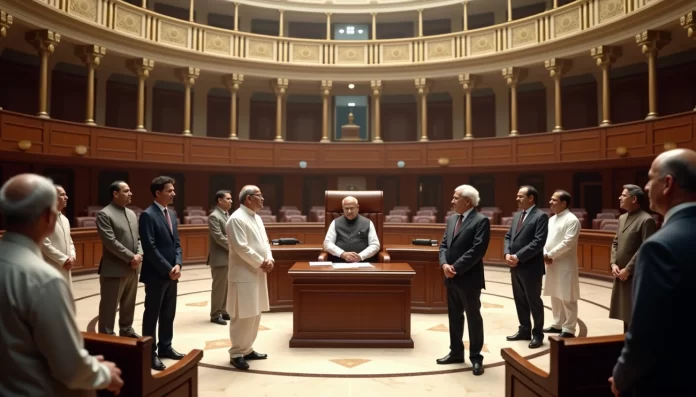
The upcoming Indian presidential election season sparks widespread interest among voters. The 2022 presidential election made history with a remarkable 99.12% voter turnout. Droupadi Murmu emerged victorious against Yashwant Sinha with a margin of 296,626 votes. Her victory marked several historic firsts. She became the first person from a Scheduled Tribe and the second woman to hold India’s highest office. She also earned the distinction of being the first president born after independence.
The 2026 presidential election brings fresh speculation about potential candidates for this prestigious role. The electoral process captures attention with its unique structure. The electoral college consists of 776 Members of Parliament and 4,036 Members of Legislative Assemblies, requiring a majority threshold of 543,216 votes. Political dynamics have evolved since the recent Vice Presidential election. The National Democratic Alliance demonstrated its strength by securing 452 votes against the opposition’s 300. The potential candidates represent diverse political backgrounds and achievements that could shape India’s future. This piece breaks down essential information about possible contenders who might appear on the 2026 presidential ballot.
Droupadi Murmu

Image Source: Al Jazeera
Droupadi Murmu, the first tribal woman to serve as President of India, stands out among potential Indian president candidates for the 2026 election. Her presidency has set new standards for representation in India’s highest office, making her a strong contender on any Indian president candidates list.
Droupadi Murmu background
Born as Puti Tudu on June 20, 1958, in Uparbeda village of Odisha’s Mayurbhanj district, Murmu belongs to the Santhal tribal community. She showed remarkable strength early in life. She grew up in one of India’s most remote regions until a teacher named her Droupadi. Despite financial hardships, she became her village’s first woman graduate. She earned her Bachelor of Arts degree in Political Science and Economics from Ramadevi Women’s College, Bhubaneswar in 1979. Her father, Biranchi Narayan Tudu, worked as a farmer. Both he and Murmu’s grandfather led their traditional village council. Life tested her resilience when she lost her husband Shyam Charan Murmu and two sons.
Droupadi Murmu political experience
Murmu started her political career in 1997 after winning the election as councilor of Rairangpur Nagar Panchayat. She demonstrated hands-on leadership by personally overseeing sanitation work under the sun during drain cleaning operations. She went on to serve two terms in the Odisha Legislative Assembly (2000-2009) representing Rairangpur. She held vital ministerial roles from 2000 to 2004, including Commerce and Transport (March 2000-August 2002) and Fisheries and Animal Resources Development (August 2002-May 2004). She led several committees including Home, Railways, and Women and Child Welfare. Her administrative skills shone through when she became Jharkhand’s 9th Governor, serving the longest tenure (6 years, 55 days) of any Governor in the state from 2015 to 2021.
Droupadi Murmu party affiliation
The BJP welcomed Murmu as a member in 1997. She has held several key party positions: BJP District President of Mayurbhanj (twice), BJP National Vice-President of the ST Morcha, and State President of BJP ST Morcha in Odisha. The National Democratic Alliance (NDA), led by the BJP, nominated her for presidency in June 2022. She won a clear majority on July 21, 2022, defeating opposition candidate Yashwant Sinha with 676,803 electoral votes (64.03%).
Droupadi Murmu key achievements
Murmu’s achievements stand out with several historic firsts:
- First person from a tribal community to become President of India
- Second woman after Pratibha Patil to hold India’s highest office
- Youngest person (at 64) to occupy the presidential post
- First president born after India’s independence in 1947
The Odisha Legislative Assembly recognized her excellence with the Pandit Nilkanth Das Best Legislator Award in 2007. Her governorship brought positive changes to Jharkhand’s State Universities’ examination and recruitment processes. She also improved education quality in Kasturba Gandhi Balika Vidyalayas. Her efforts helped Santali language gain constitutional recognition as an official language of India.
Droupadi Murmu presidential vision
President Murmu focuses on governance reforms, inclusive growth, and cultural decolonization. She supported the ‘One Nation One Election’ plan in her 2026 Republic Day eve address. She noted this plan could boost governance consistency, prevent policy paralysis, reduce resource diversion, and cut financial burden. She actively supports initiatives for marginalized communities, especially those from Scheduled Castes, Scheduled Tribes, and Other Backward Classes. Her commitment to India’s cultural heritage shows in her promotion of traditional Indian art, crafts, textiles, and cuisine at state functions.
Droupadi Murmu support base
Tribal communities across India see Murmu’s presidency as “a triumph of tribal political aspirations and a breakthrough moment for the community”. The BJP and its National Democratic Alliance partners backed her historic election. Odisha’s political leaders celebrated her nomination, calling her a “daughter of the soil”. People admire her beyond tribal communities for her simplicity, straightforwardness, and dedication to social justice.
Yashwant Sinha

Image Source: YouTube
Yashwant Sinha stands out as a strong contender on the Indian president candidates list. His decades of administrative and political experience add weight to his potential 2026 candidacy. His presidential bid in 2022 made him one of the most important figures among Indian president election candidates.
Yashwant Sinha background
Sinha was born on November 6, 1937, in Patna, Bihar to a Kayastha family. He earned his Master’s degree in Political Science from the University of Patna in 1958. Before starting his political career, he taught Political Science at his alma mater from 1958 to 1960. He ranked an impressive 12th nationwide in the UPSC Civil Services Examination and joined the Indian Administrative Service in 1960. His 24-year IAS career included several key positions. He worked as First Secretary (Commercial) in the Indian Embassy in Bonn and as Consul General in Frankfurt (1973-1974). These roles helped him build expertise in foreign trade and European Economic Community relations.
Yashwant Sinha political experience
Sinha began his political career in 1984 when he left the IAS to join the Janata Party. He has extensive experience in governance. He served twice as Union Finance Minister – first under Prime Minister Chandra Shekhar (1990-1991) and later under Prime Minister Atal Bihari Vajpayee (1998-2002). He also led the External Affairs Ministry from July 2002 until May 2004. His electoral success includes winning a Rajya Sabha seat in 1988 and multiple Lok Sabha victories from Hazaribagh constituency (1998, 1999, and 2009).
Yashwant Sinha party affiliation
Sinha’s political path has taken him through several parties. He started with the Janata Party in 1984 and moved to the Janata Dal during its formation in 1989. He then joined the BJP in the 1990s and became its National Spokesperson in 1996. After 24 years with the BJP, he left in 2018 because he felt democracy was being undermined. He joined the Trinamool Congress in March 2021 as its vice president. He stepped down from TMC in June 2022 before becoming the joint opposition’s presidential candidate.
Yashwant Sinha key achievements
As Finance Minister under Vajpayee, Sinha brought several important reforms:
- He changed the 53-year British-era tradition of presenting the Indian budget at 5 pm to a time that worked better for India’s Parliament
- He introduced tax deductions for mortgage interest and reduced real interest rates
- He made the telecommunications sector more open, which helped start the mobile phone revolution
- He boosted infrastructure development with a 35% increase in allocations in his 1998 budget
- He wrote the landmark Fiscal Responsibility & Budget Management Act that put legal limits on government deficits
France recognized his contributions with its highest civilian honor, the Officier de la Légion d’Honneur.
Yashwant Sinha presidential vision
Sinha sees the President’s role as an active constitutional guardian rather than just a ceremonial figure. During his 2022 campaign, he stressed that “India needs a Rashtrapati who serves as the impartial custodian of the Constitution and not one who acts as a rubber stamp for the government”. He wants a “thinking, speaking President” who protects democratic institutions. His vision focuses on defending secularism and encouraging politics of consensus. He aims to prevent what he calls attempts to create a “One Nation, One Party, One Supreme Leader” governance model.
Yashwant Sinha support base
Sinha got backing from many opposition parties in the 2022 presidential election. He launched his campaign in Kerala, where both the CPI(M)-led Left Democratic Front and Congress-led United Democratic Front supported him. The Rashtriya Janata Dal-led opposition in Bihar, including Congress and Left parties, also backed his candidacy. The Telangana Rashtra Samithi (TRS) showed its support when Chief Minister K. Chandrasekhar Rao hosted a reception for him. Though Droupadi Murmu won the election, Sinha’s campaign showed strong opposition unity. This puts him in a good position as a potential returning Indian presidential candidate for future elections.
Sharad Pawar

Image Source: YouTube
Sharad Pawar stands out as a seasoned statesman among Indian president candidates for 2026. His exceptional political career spans over 63 years. People often call him “the best Prime Minister India never had”, and this political maverick brings exceptional experience to the Indian president candidates list.
Sharad Pawar background
Sharadchandra Govindrao Pawar was born on December 12, 1940, in Baramati, Maharashtra. He comes from a farming community in Katewadi village. His mother’s political activism before India’s independence shaped his early political interests. Sharada Pawar welcomed many respected figures during the Sanyukta Maharashtra struggle. He started his education at Maharashtra Education Society school and later went to BrihanMaharashtra Commerce College where he served as General Secretary. His leadership qualities showed through his success in debates, sports activities organization, and his role in the Goa Liberation Movement.
Sharad Pawar political experience
His political experience started in 1958 with the Youth Congress. He quickly rose to become Pune district Youth Congress president by 1962. His first election victory came at age 27 when he won the Maharashtra Legislative Assembly seat from Baramati in 1967. His remarkable career includes serving as:
- Maharashtra’s Chief Minister four times (1978, 1988-91, 1990-91, and 1993-95)
- Defense Minister under P.V. Narasimha Rao (1991-1993)
- Agriculture Minister under Manmohan Singh (2004-2014)
- Member of both the Lok Sabha and Rajya Sabha multiple times
He became Maharashtra’s youngest Chief Minister at 38 in 1978, which proved his early political wisdom.
Sharad Pawar party affiliation
His party affiliations reflect his political pragmatism. He started with Congress but split from the party in 1999 alongside P.A. Sangma and Tariq Anwar over Sonia Gandhi’s foreign origin. He then created the Nationalist Congress Party (NCP) in June 1999. The NCP faced a major split when his nephew Ajit Pawar left with most MLAs in July 2023 to join the ruling Shiv Sena-BJP government. The Election Commission awarded the party name and symbol to Ajit Pawar’s faction in February 2024. This led Sharad Pawar to establish the Nationalist Congress Party-Sharadchandra Pawar (NCP-SP).
Sharad Pawar key achievements
His career highlights include:
- Leading Maharashtra’s growth in cooperatives and agro-industries
- Reshaping the scene in Pune as an IT hub and transforming Western Maharashtra economically
- Raising pension pay for retired defense officers during his Defense Minister tenure
- Starting orchard development schemes and advancing sugar industry development
- Receiving the Padma Vibhushan, India’s second-highest civilian honor, in 2017
- Leading the Board of Control for Cricket in India (2005-2008) and International Cricket Council (2010-2012)
Sharad Pawar presidential vision
As a potential Indian presidential candidate, Pawar promotes active defense of constitutional values. Opposition leaders saw him as an ideal candidate for the 2022 presidency. They believed he could “protect the Constitution, institutions and citizenry from the ongoing onslaught by the ruling party”. His vision focuses on building consensus and encouraging unity among diverse political factions. He believes the presidency must protect democratic institutions, stating that India needs “a person as President who can protect the Constitution”.
Sharad Pawar support base
Leaders from all sides respect Pawar. He managed to keep good relations with leaders of various parties, including Telangana Chief Minister K. Chandrasekhar Rao and Odisha Chief Minister Naveen Patnaik. He proved his ability to unite different groups by forming the Maha Vikas Aghadi coalition in 2019. Prime Minister Narendra Modi once called him his “political guru”, showing how much respect he commands across party lines. The 2026 presidential race might see Pawar getting support from opposition parties looking for an experienced consensus candidate with strong cross-party connections.
Gopalkrishna Gandhi

Image Source: The Better India
Gopalkrishna Gandhi stands out among leading Indian president candidates with his exceptional heritage and service record. As the grandson of two iconic figures—Mahatma Gandhi and C. Rajagopalachari—he brings a fresh viewpoint to the Indian president candidates list for 2026.
Gopalkrishna Gandhi background
Gopalkrishna Gandhi was born April 22, 1945, in Delhi to journalist Devdas Gandhi and Lakshmi Gandhi. His family’s legacy ties directly to India’s independence movement—he is Mahatma Gandhi’s youngest grandson through his father and C. Rajagopalachari’s maternal grandson, India’s last Governor-General. He earned his Master’s degree in English literature from St. Stephen’s College, Delhi, and went on to build a career that spans administration, diplomacy, and academia. His background sets him apart from other presidential candidates by bridging both intellectual and public service realms.
Gopalkrishna Gandhi political experience
Gandhi’s rich career started with the Indian Administrative Service in 1968, where he served in Tamil Nadu until 1985. His diplomatic roles include:
- High Commissioner to South Africa and Lesotho (1996)
- Secretary to the President of India (1997-2000)
- High Commissioner to Sri Lanka (2000)
- Ambassador to Norway and Iceland (2002)
His most significant political role came as Governor of West Bengal from 2004 to 2009. He guided the state through some of its most turbulent political periods, including the Singur and Nandigram disputes. He also served as Governor of Bihar in 2006.
Gopalkrishna Gandhi party affiliation
Gandhi stands apart from typical Indian president election candidates with his non-partisan stance. During his 2017 Vice-Presidential candidacy, though nominated by opposition parties, he called himself “a citizen candidate who has been asked by a large spectrum of Opposition parties to contest without party bias”. “I am not a politician,” he once stated. This independent approach makes him unique among potential next Indian president candidates.
Gopalkrishna Gandhi key achievements
Gandhi’s work spans multiple fields:
- He wrote several acclaimed books including the novel “Saranam” (Refuge) about Sri Lankan Tamil plantation workers
- He translated Vikram Seth’s “A Suitable Boy” into Hindi as “Koi Achchha Sa Ladka”
- He served as the first Director of The Nehru Center in London
- He created the first district gazetteer for Pudukkottai as an IAS officer
- He now serves as Distinguished Professor of History and Politics at Ashoka University
Gopalkrishna Gandhi presidential vision
Gandhi sees the presidency as a guardian of constitutional values. He believes presidents, vice-presidents and governors should stay above partisan politics, stating that those “who are not in the political race and are outside are important”. After the 2014 election, Gandhi wrote to PM Modi highlighting that “India’s minorities are not a segment of India, they are an infusion in the main”. This shows his dedication to inclusive leadership. Though he declined to run in the 2022 presidential race, he suggested the candidate should “generate a national consensus” beyond party lines.
Gopalkrishna Gandhi support base
Gandhi commands respect across political lines. In 2022, Left parties strongly backed him, with CPI(M) general secretary Sitaram Yechury framing a potential presidential contest as “Gandhi versus Godse”. Leaders from Congress and regional parties support him for his moral authority and intellectual credentials. His principled position during West Bengal’s Nandigram crisis earned respect from both the Left Front and Trinamool Congress. This shows his skill in maintaining credibility across political divides.
Meira Kumar

Image Source: The Better India
Meira Kumar, a pioneer in gender representation in Indian politics, stands out among indian president candidates with her groundbreaking achievement as the first woman Lok Sabha Speaker. Her distinguished career makes her a notable indian presidential candidate for 2026.
Meira Kumar background
Kumar was born on March 31, 1945, in Patna (now Bihar) into a prominent Dalit family. Her parents were freedom fighter and former Deputy Prime Minister Jagjivan Ram and freedom activist Indrani Devi. She completed her education at Welham Girls’ School and Delhi University, earning M.A. in English Literature and LL.B degrees. Banasthali Vidyapith awarded her an honorary doctorate in 2010.
Meira Kumar political experience
Kumar’s career began in the Indian Foreign Service where she served from 1973 to 1985, with diplomatic assignments in Spain and the United Kingdom. Prime Minister Rajiv Gandhi’s request led her to leave diplomacy and enter electoral politics. She won five terms as Member of Parliament, representing constituencies across Uttar Pradesh, Delhi, and Bihar. Her most significant role came as the first woman Speaker of Lok Sabha from 2009 to 2014.
Meira Kumar party affiliation
Kumar’s ties with the Indian National Congress have remained strong through her career. She took on the role of General Secretary of the All India Congress Committee (1991-1992 and 1996-1999) and served on the Congress Working Committee for a decade (1990-2000). A brief resignation from the party in 2000 due to leadership differences ended with her return in 2002.
Meira Kumar key achievements
Kumar’s career highlights showcase several historic milestones:
- First woman elected as Speaker of Lok Sabha (2009-2014)
- Minister of Social Justice and Empowerment (2004-2009)
- Briefly served as Minister for Water Resources (2009)
- As Speaker, introduced gender-neutral rules in the House
- Reduced paper usage by 30% in Lok Sabha by issuing tablet computers
Meira Kumar presidential vision
Kumar sees the presidency as constitutional guardianship beyond partisan politics. She states that the role “articulates the basis of our electoral philosophy – that capability and experience must always supersede all other considerations”. She supports inclusiveness, social justice, pluralism, and defends constitutional principles.
Meira Kumar support base
Kumar got backing from 17 political parties as the opposition’s presidential nominee in 2017, including Congress, Left, NCP, RJD and DMK. Her campaign put ideological values ahead of caste considerations, and she got support from the Janata Dal (Secular). This broad coalition shows her strength as a consensus candidate among indian president election candidates for 2026.
Venkaiah Naidu

Image Source: Reuters
Muppavarapu Venkaiah Naidu stands out among Indian presidential candidates because of his rich parliamentary experience and Southern political roots. His candidacy brings regional diversity to the Indian president candidates list for 2026.
Venkaiah Naidu background
Naidu was born on July 1, 1949, in Chavatapalem, a remote village in Nellore district of Andhra Pradesh. He comes from an agricultural family where his father Rangaiah Naidu worked as a farmer. After completing his studies at V.R. College, Nellore, he got his law degree from Andhra University in Visakhapatnam. His political journey began at age 14 when he joined the RSS shakha in 1963 to play kabaddi. As a student leader, he led the Students’ Union at V.R. College in 1971 and at Andhra University Colleges in 1973-74.
Venkaiah Naidu political experience
Naidu’s five-decade experience in politics includes several key positions:
- Vice President of India (2017-2022)
- Union Minister of Information and Broadcasting (2016-2017)
- Union Minister of Urban Development (2014-2017)
- Union Minister for Rural Development (2000-2002)
- National President of BJP (2002-2004)
- Member of Parliament, Rajya Sabha for four terms
His leadership boosted the Rajya Sabha’s productivity by 70% during his tenure as Chairman across 13 sessions.
Venkaiah Naidu party affiliation
Naidu maintained strong ties with the Bharatiya Janata Party and served as its National President from 2002 to 2004. His emotional connection to the party became evident when he stepped down to become Vice President, saying “there were tears not for shirking responsibility but because I have to leave the party which has given me all these”. His political roots go back to the Jana Sangh, which he joined after listening to Atal Bihari Vajpayee at a public meeting in 1967.
Venkaiah Naidu key achievements
Naidu’s notable accomplishments include:
- Taking Rajya Sabha productivity to its peak of 82.27% in 2020
- Leading the passage of crucial legislation including Jammu and Kashmir Reorganization Bill in 2019
- Encouraging Indian languages in parliamentary proceedings with first-ever use of Dogri, Konkani, Kashmiri and Santhali in Rajya Sabha
- Receiving the Padma Vibhushan, India’s second-highest civilian honor, in 2024
Venkaiah Naidu presidential vision
Naidu sees the presidency as a constitutional guardian. He believes people want three D’s from democratic institutions: “discuss, debate and decide” rather than disruption. During his vice presidency, he stressed parliamentary decorum, noting that “the value systems are declining. Keep that in mind and try to do your bit”. Unlike other candidates, he clearly stated he “never aspired to be president” and would not become “a dissident”.
Venkaiah Naidu support base
At 75, Naidu could emerge as a strong southern candidate in a predominantly north-dominated political landscape. Many consider him “an ideal candidate” for president given his “long career in politics, positioning as a southern face in national politics, friendly ties cutting across party lines, immense experience in governance and command over multiple languages”. His knack for winning “friends and foes across the political spectrum” through witty one-liners and puns might help build consensus.
Mallikarjun Kharge

Image Source: BBC
Mallikarjun Kharge stands out as a compelling choice among Indian presidential candidates. His exceptional political resilience throughout his career makes him a strong contender for India’s presidency in 2026. His path from grassroots politics to national leadership sets him apart from other candidates.
Mallikarjun Kharge background
Kharge’s story began in Varawatti village, Bhalki Taluk, Bidar district, Karnataka, where he was born on July 21, 1942, into a Dalit family. His life took a tragic turn when he was just seven years old. He managed to survive a deadly fire set by the Razakars of the Nizam of Hyderabad that took his mother’s and sister’s lives in 1948. He pushed through this devastating loss and completed his education at Nutan Vidyalaya in Gulbarga. He earned his Bachelor of Arts from Government College, Gulbarga and later got his law degree from Seth Shankarlal Lahoti Law College. His legal career started in Justice Shivaraj Patil’s office, where he worked on labor union cases.
Mallikarjun Kharge political experience
His political story started as a student leader before he became President of Gulbarga City Congress in 1969. His impressive electoral track record shows nine straight terms as MLA in Karnataka’s Legislative Assembly (1972-2009). He served Karnataka in various roles – as Minister for Education, Revenue, Rural Development, Home Affairs, and Water Resources. His move to national politics saw him win two Lok Sabha elections from Gulbarga (2009-2019). He now serves as a Rajya Sabha member from Karnataka since 2020 and became Leader of Opposition in 2021.
Mallikarjun Kharge party affiliation
Kharge’s steadfast dedication to the Indian National Congress defines his political journey. He led as Karnataka Pradesh Congress Committee President (2005-2008) and served as Leader of Congress in the Lok Sabha. He made history in October 2022 by defeating Shashi Tharoor in the Congress presidential election. This victory made him the first non-Gandhi family president in 24 years and the first Dalit to lead the party.
Mallikarjun Kharge key achievements
His remarkable winning streak in nine consecutive assembly elections earned him the nickname “Solillada Saradara” (leader without defeat), which lasted until his 2019 Lok Sabha loss. As Labor Minister and Railways Minister (2009-2014), he championed workers’ rights and social justice. The insertion of Article 371J for Karnataka’s Kalyan region development stands as one of his proudest achievements. Congress formed governments in Himachal Pradesh, Telangana, and joined a coalition in Jharkhand under his leadership.
Mallikarjun Kharge presidential vision
Kharge wants to protect democratic institutions from what he calls “sustained pressure”. He supports protecting the Election Commission’s independence and speaks out against attempts to “bulldoze” democracy. He criticized the President’s address to Parliament recently for its lack of “vision or direction” and overlooking challenges faced by poor, Dalits, and minorities. He warned in 2026 that the “very foundations of the republic” were under strain.
Mallikarjun Kharge support base
Mamata Banerjee and Arvind Kejriwal suggested Kharge as the INDIA alliance’s prime ministerial candidate in 2022, though Lalu Yadav had different views. He ended up becoming the alliance’s chairman. While he has strong support among Dalit communities, his son Priyank questions why people see his father only as a “Dalit leader” instead of recognizing his capabilities whatever his community.
Sushilkumar Shinde

Image Source: The Economic Times
Sushilkumar Shinde, Maharashtra’s first Dalit Chief Minister, stands out as a strong contender for the Indian presidency. His life story reflects an exceptional rise from modest roots to political leadership.
Sushilkumar Shinde background
Sambhajirao and Sakhu Bai welcomed their son Sushilkumar Shinde on September 4, 1941, in Solapur, Maharashtra. He belongs to the Dhor caste, known for their traditional work of processing dead cattle skins for leather goods. His father’s death in 1947 brought severe financial struggles to the family. Despite these challenges, Shinde earned an honors degree from Dayanand College, Solapur and later got law degrees from ILS Law College and New Law University of Bombay.
Sushilkumar Shinde political experience
The future leader started his career as a court clerk before becoming a sub-inspector in Maharashtra Police. A meeting with Sharad Pawar changed his path toward politics in 1971. His remarkable political career includes roles as Maharashtra’s Chief Minister (2003-2004), Andhra Pradesh’s Governor (2004-2006), Union Power Minister (2006-2012), and Home Minister (2012-2014). Multiple victories in Maharashtra state assembly elections marked his political success.
Sushilkumar Shinde party affiliation
Congress became Shinde’s political home in 1971. He briefly joined Sharad Pawar’s Progressive Democratic Front Government in 1978 but returned to Congress after its dismissal in 1980. Today, he remains loyal to the Gandhi family.
Sushilkumar Shinde key achievements
Shinde’s legacy as Maharashtra’s first Dalit Chief Minister includes creating financial support for bright students from disadvantaged backgrounds to study abroad. His term as Home Minister saw the executions of terrorists Ajmal Kasab and Afzal Guru. Civilian casualties from terrorism dropped significantly under his leadership, falling from 540 to 278.
Sushilkumar Shinde presidential vision
Constitutional protections without political interference remain central to Shinde’s beliefs. He expressed worry about the strengthened Unlawful Activities Prevention Act, stating: “I feel sad to see how it has been misused to curb civil rights and legitimate political dissent. That was never our intention”.
Comparison Table
| Candidate | Birth Year/Age | Educational Background | Key Positions Held | Party Affiliation | Notable Achievements | Political Experience |
|---|---|---|---|---|---|---|
| Droupadi Murmu | 1958 (65) | BA in Political Science & Economics from Ramadevi Women’s College | – President of India (Current) – Governor of Jharkhand (2015-2021) – Minister in Odisha Govt (2000-2004) | BJP (since 1997) | – Made history as India’s first tribal President – Second woman to hold presidency – Youngest President at age 64 – First President born after independence | 25+ years (since 1997) |
| Yashwant Sinha | 1937 (86) | MA in Political Science from University of Patna | – Finance Minister (1990-91, 1998-2002) – External Affairs Minister (2002-2004) | Multiple (Former BJP, TMC, now Independent) | – Spearheaded major financial reforms – Received Officier de la Légion d’Honneur – Secured 12th rank in UPSC | 40+ years (since 1984) |
| Sharad Pawar | 1940 (83) | Commerce from BrihanMaharashtra College | – Agriculture Minister (2004-2014) – Defense Minister (1991-1993) – CM Maharashtra (4 terms) | NCP-SP (Founded NCP in 1999) | – Honored with Padma Vibhushan (2017) – Became Maharashtra’s youngest CM at 38 – Led BCCI (2005-2008) | 63+ years (since 1958) |
| Gopalkrishna Gandhi | 1945 (78) | MA in English Literature from St. Stephen’s College | – Governor of West Bengal (2004-2009) – High Commissioner to South Africa & Sri Lanka | Non-partisan | – Accomplished diplomat – Published several books – Pioneered as first Director of Nehru Center, London | IAS (1968-1985) + Diplomatic service |
| Meira Kumar | 1945 (78) | MA in English Literature, LLB from Delhi University | – First woman Lok Sabha Speaker (2009-2014) – Minister of Social Justice | Congress | – Broke barriers as first woman Lok Sabha Speaker – Served as IFS officer (1973-1985) – Secured 5 terms as MP | 35+ years (since mid-1980s) |
| Venkaiah Naidu | 1949 (74) | Law degree from Andhra University | – Vice President (2017-2022) – BJP National President (2002-2004) – Multiple Union Minister roles | Former BJP (resigned for VP role) | – Awarded Padma Vibhushan (2024) – Raised Rajya Sabha productivity to 82.27% | 50+ years (since early 1970s) |
| Mallikarjun Kharge | 1942 (81) | BA and Law degree from Gulbarga | – Congress President (Current) – Leader of Opposition in Rajya Sabha – Railways Minister | Congress | – Secured 9 consecutive Assembly victories – First non-Gandhi Congress President in 24 years | 50+ years (since 1969) |
| Sushilkumar Shinde | 1941 (82) | Law degrees from ILS Law College & New Law University of Bombay | – Home Minister (2012-2014) – CM Maharashtra (2003-2004) – Governor of Andhra Pradesh | Congress | – Pioneered as first Dalit CM of Maharashtra – Oversaw Kasab and Afzal Guru executions | 50+ years (since 1971) |
FAQs
Q1. Who are the leading contenders for the 2026 Indian presidential election? While it’s too early to name specific candidates, potential contenders include current and former politicians like Droupadi Murmu, Yashwant Sinha, Sharad Pawar, Gopalkrishna Gandhi, Meira Kumar, Venkaiah Naidu, Mallikarjun Kharge, and Sushilkumar Shinde. The final candidates will likely be nominated by major political alliances closer to the election date.
Q2. What qualifications are required to become the President of India? To be eligible for the presidency, a candidate must be an Indian citizen, at least 35 years old, and qualified to be elected as a member of the Lok Sabha. They should not hold any office of profit under the government and possess the educational and political experience typically expected for such a high office.
Q3. How is the President of India elected? The President is elected indirectly by an electoral college consisting of elected members of both houses of Parliament and the legislative assemblies of states and union territories. The voting is done through a secret ballot using the single transferable vote system of proportional representation.
Q4. What role does the President play in India’s governance? The President of India is the head of state and the supreme commander of the armed forces. While largely ceremonial, the President’s role includes appointing the Prime Minister, dissolving the Lok Sabha on the advice of the cabinet, and granting pardons. The President also serves as a symbol of national unity and upholds the constitution.
Q5. Can a President serve multiple terms? Yes, a President can serve multiple terms, but each term is limited to five years. There is no limit on the number of terms a person can serve as President, provided they are re-elected. However, in practice, most Indian Presidents have served single terms.

