


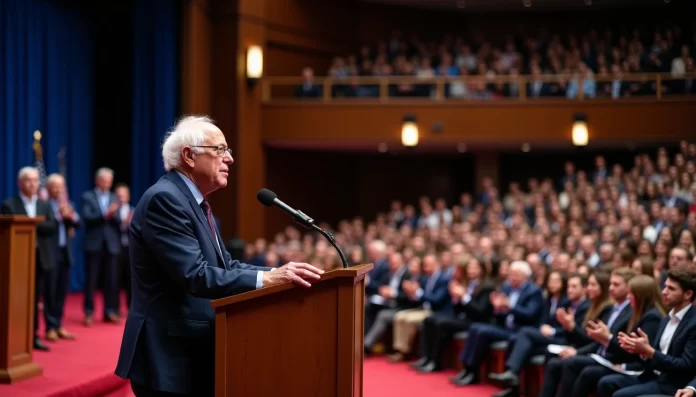
Bernie Sanders made history as the first Democratic presidential candidate to visit Liberty University, a conservative religious college that traditionally hosted Republican presidential hopefuls for decades. The Vermont Senator received a respectful welcome at this stronghold of conservative values, creating an extraordinary moment in American political discourse. The student body filled the large auditorium and listened attentively throughout his remarks.
Sanders’ appearance generated most important interest because of his progressive views and unique political standing. Students wanted to know simple questions about his age and whether he identified as a Democrat, given his independent position in Congress. The event concluded with a memorable moment as students stood and cheered loudly during a question about abortion. This unexpected reception at Liberty University shows how political dialog can exceed partisan boundaries through mutual respect.
Bernie Sanders speaks at Liberty University
Bernie Sanders stepped onto Liberty University’s Vines Center stage in Lynchburg, Virginia on September 14, 2015. Nearly 12,000 students gathered for what’s known as Convocation – the world’s largest regular assembly of Christian young people. Liberty’s Campus Band led the residential students in worship, and their singing drowned out the band’s music.
Event details: date, location, and context
Jerry Falwell, Liberty University’s president, presented Sanders with a Flames Football jersey that bore his name. The atmosphere differed from Sanders’ usual campaign stops. Rather than progressive rallies, he spoke after prayers and Christian rock performances. Students must attend Convocation with just one allowed absence per term, yet the audience stayed respectful throughout.
Why Liberty University invited Sanders
Liberty University reached out to every 2016 presidential candidate to show their students different viewpoints. David Nasser, Liberty’s senior vice president for spiritual development, explained how President Falwell wanted Convocation to serve as “a platform for ideas, where students can hear from influential speakers from across the professional spectrum and be challenged to know ‘not just what to think, but how to think'”.
How old is Bernie Sanders and why that matters to students
College students often discuss Sanders’ age. At 83 years old (as of 2026), he aims to win his fourth Senate term. His age sparks questions much like those about President Biden, who struggled during the presidential debate against Trump at age 81.
Sanders’ unique personality and cultural image help him connect with younger people effectively. A Middlebury student pointed out that people see Sanders as “an octogenarian and an icon for Gen Z”. Students value his role in expanding American politics’ boundaries, even though age concerns exist – he would turn 89 by the end of another term.
Sanders challenges students to find common ground
Sanders spoke with a hoarse voice from his campaign trail speeches when he first acknowledged the ideological differences between himself and the audience. “I understand that issues such as abortion and gay marriage are very important to you and that we disagree on those issues,” he stated directly. “I get that. But let me respectfully suggest that there are other issues out there that are of enormous consequence to our country and the world and that maybe, just maybe, we don’t disagree on them”.
Opening remarks on ideological differences
The heart of Sanders’ message was about finding shared moral ground instead of dwelling on differences. “I believe from the bottom of my heart that it is vitally important for those of us who hold different views to be able to participate in a civil discourse,” he remarked. He noted that anyone can talk with people who share their views, but real progress comes from communicating with those who think differently. His speech centered on economic inequality as a moral issue that could bring conservatives and progressives together.
Use of scripture and Pope Francis to build bridges
Sanders connected with his evangelical audience by quoting familiar Bible passages, including Amos 5:24: “Let justice roll down like waters, and righteousness like an ever-flowing stream”. He quoted Matthew 7:12, the Golden Rule, that says “Do unto others what you would have them do to you”. Sanders found common ground with Pope Francis, pointing out their shared belief that love of money has become “the modern-day equivalent of idol worship”. This reference put his economic views in a broader religious context.
Is Bernie Sanders a Democrat? His independent stance explained
Sanders’ relationship with the Democratic Party has never been simple. He runs in Democratic primaries but calls himself an independent—he’s “the longest-serving independent in the history of the United States Congress”. He filed paperwork to run for Senate reelection in 2024 as an independent. He has encouraged progressive leaders to run as independents outside the Democratic Party. This position shows his commitment to reshape American politics beyond traditional party lines.
Audience responds with respect and emotion
Liberty University students welcomed Sanders with polite but lukewarm applause. Students sat quietly with their arms crossed and clapped occasionally during his speech. His usual talking points didn’t spark the same excitement they typically do at progressive gatherings.
Standing ovation moments and applause lines
The Q&A session after Sanders’ speech created the most memorable moment. David Nasser, Liberty’s senior vice president for spiritual development, asked about the apparent conflict between caring for vulnerable children and supporting abortion rights. The audience jumped to their feet with thunderous applause. This reaction stood out as the most energetic response during the whole ordeal.
Student reactions: from admiration to disagreement
Students had mixed feelings about the address. Student body president Quincy Thompson, who briefly met Sanders later, said “Calling on us to help the neediest, that appeals to me as a Christian”. Some students couldn’t settle with Sanders’ progressive views. Adam Ochs, a sophomore political science major, asked “How can he be for family values but also for abortion?”.
Derek Atlas, a 19-year-old Liberty student, liked Sanders’ economic message: “I believe Christ tells us to help the poor, feed the needy, and shelter the homeless. I like how Sanders wages war on poverty, not poor people”. Many students managed to keep their political differences. Kevin Betsch explained, “We’re trying to uphold Christian values. I’d say all but one of these students did not agree with him on everything”.
Faculty and moderator responses to Sanders’ tone
Faculty members appreciated Sanders’ respectful approach. The university leadership saw the visit as meeting their founder’s vision. A university publication noted that Sanders’ appearance arranged with “the precedent set 32 years ago by our founder: that we must not run from opposing views, but come, lovingly and open-mindedly, to hear and be better informed”.
Sanders reframes moral issues through economic justice
Bernie Sanders focused his message on economic justice as a fundamental moral issue throughout his address. “When we talk about morality and justice, we have to understand that there is no justice when so few have so much and so many have so little,” he declared. His message about wealth inequality reached beyond political divisions.
Focus on income inequality and the billionaire class
Sanders stressed that America’s wealth concentration has created a moral crisis. “There is no justice,” he stated, “when the top one-tenth of one percent own almost as much wealth as the bottom 90 percent”. He pointed out that 20% of American children—and 40% of African-American children—live in poverty. He also criticized Republican budget proposals that cut children’s healthcare funding and reduce taxes “for the top 2%,” calling these actions fundamentally immoral.
Abortion question and Sanders’ respectful rebuttal
The Q&A session’s most powerful moment came when Sanders answered a question about protecting “children in the womb”. Students burst into thunderous applause, and Sanders acknowledged their different viewpoint while he managed to keep his position. “I believe it is improper for the United States government or state government to tell every woman in this country the very painful and difficult choice she has to make,” he responded. He then shifted the discussion to childhood poverty as an issue Christians should prioritize.
Bernie Sanders polls: how this speech may influence perception
Sanders’ recent polls showed strong momentum, especially in early voting states. He led Hillary Clinton by 43% to 33% among likely Iowa primary voters and by 52% to 30% in New Hampshire. His Liberty University appearance could expand his appeal beyond traditional progressive supporters, as he showed willingness to participate respectfully with conservative audiences.
Conclusion
Bernie Sanders’ speech at Liberty University ended up as a powerful example of building bridges across America’s growing ideological divide. He showed how politicians can connect respectfully with audiences who see the world differently. His honest approach to acknowledging disagreements while finding moral common ground offered a fresh alternative to the usual hostile political rhetoric.
The way Liberty students received Sanders revealed something special about both sides. These conservative students were open to listening and talking about different points of view. Sanders showed real respect for the evangelical community. He connected his economic justice message through biblical references and respected their core beliefs, even on tough issues like abortion.
The event’s biggest impact was showing how economic inequality could bring progressives and religious conservatives together. Many students connected Sanders’ message about childhood poverty and wealth concentration with their Christian values of helping those in need.
Sanders’ role as an independent helped make this conversation possible. Students saw him as someone ready to challenge party lines rather than just push Democratic talking points. His age wasn’t a weakness – it gave him credibility that appealed to young people on both sides.
The students gave Sanders a standing ovation not because he changed his beliefs, but because he spoke about them honestly. Americans are hungry for political discussions based on mutual respect instead of attacks. Many Liberty students still disagreed with Sanders on several issues, but they saw firsthand how democratic debate works when people focus on understanding each other.
This remarkable moment at Liberty University teaches us that real political dialog needs courage to step into uncomfortable spaces and humility to truly listen. Sanders’ visit might not have swayed many votes, but it showed how America’s divided political world could start healing through open, respectful conversations across our deepest differences.
FAQs
Q1. Why did Bernie Sanders speak at Liberty University? Bernie Sanders was invited to speak at Liberty University as part of the university’s commitment to exposing students to diverse viewpoints. The university extends invitations to all presidential candidates, aiming to challenge students to think critically about different ideas and perspectives.
Q2. How did the Liberty University audience respond to Sanders’ speech? The audience at Liberty University responded with respect and attentiveness. While applause was initially tepid, students listened quietly throughout Sanders’ remarks. The most dramatic moment came during the Q&A session when a question about abortion led to a standing ovation from the audience.
Q3. What was the main focus of Sanders’ speech at Liberty University? Sanders focused primarily on economic justice as a moral issue that could potentially unite conservatives and progressives. He framed wealth inequality as a fundamental moral concern and emphasized the need to address childhood poverty and wealth concentration in America.
Q4. How did Sanders attempt to connect with the evangelical audience? To connect with the evangelical audience, Sanders quoted familiar Bible passages and referenced Pope Francis. He used these religious references to frame his economic arguments and find common moral ground with the conservative Christian students.
Q5. What impact did Sanders’ appearance at Liberty University have on his campaign? Sanders’ appearance at Liberty University potentially broadened his appeal beyond traditional progressive supporters. By demonstrating a willingness to engage respectfully with conservative audiences, he showcased an ability to bridge America’s ideological divide, which could have influenced perceptions of his campaign positively.

