


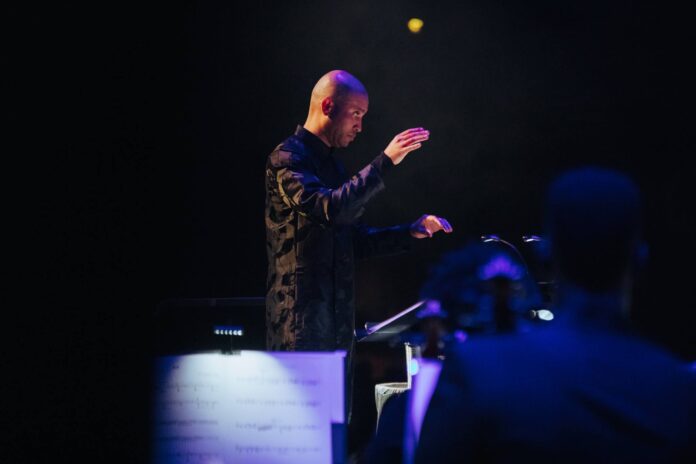
Derrick Spiva creates musical bridges between worlds by naturally blending rhythms and melodies from different continents into harmonious compositions. This Los Angeles-based artist’s remarkable heritage includes Ghanaian, Nigerian, British, Irish, and Native-American ancestry, which helps him craft a truly unique musical language.
Derrick Skye’s music (his current professional name) breaks traditional boundaries. His piece “Black Ocean,” which appears on the 2023 album “House of Belonging” by Conspirare and Miró Quartet, earned a 2024 Grammy Award nomination for Best Choral Performance. On top of that, he has developed a distinctly “American” esthetic that reflects his community’s diversity. His compositions like “Prisms, Cycles, Leaps” show both his cosmic inspirations and his commitment to creating music that gives equal importance to every style.
The sort of thing I love about this composer is his deep study of global musical traditions. He has learned West African music from Kobla Ladzekpo, Persian music from Pirayeh Pourafar and Houman Pourmehdi, Balkan theory from Tzvetanka Varimezova, and Indian classical tala from Swapan Chaudhuri. This rich musical vocabulary shines through in works like “To Be a Horizon,” which brings together Ghanaian drumming, Persian classical music, and Indian classical tala. The piece also weaves in melodic influences from West and North Africa, Bulgarian folk music, and American genres from blues to bluegrass.
Early Life and Musical Foundations
Derrick Spiva’s musical roots run deep through his remarkable family tree. He comes from a family with an impressive athletic legacy. His aunts – the Howard Sisters (Mattina, Sherri, and Denean) – earned gold and silver medals in track and field at the 1984 Los Angeles and 1988 Seoul Olympic Games. His father, Derrick Spiva Sr., teaches as a lecturer in Africana Studies at San Francisco State University, which helped shape his early cultural awareness.
Family background and cultural heritage
Spiva’s heritage includes an array of cultural influences from Ghanaian, Nigerian, British, Irish, and Native American roots. His connection to his African ancestry remains somewhat incomplete. “As an American who is a descendant of slaves, I don’t have a complete picture of exactly who my ancestors are. But I am going to claim who I am, nonetheless,” he reflects. His family’s musical foundation includes gospel, funk, and jazz traditions, which shaped his early musical experiences.
Education at UCLA and CalArts
Spiva started his formal musical training at the University of California, Los Angeles, where he studied classical trombone. A defining moment occurred when he heard West African music coming from a campus concert hall after practice. This chance encounter sparked his interest in global musical traditions. He later earned his MFA from California Institute of the Arts (CalArts), which completed his formal education and broadened his musical perspective.
Mentors and global music studies
Spiva learned from an impressive group of mentors during his academic years. His classical composition teachers included Ian Krouse, Paul Chihara, David Rosenboom, and Alex Shapiro. He studied various musical traditions with experts: West African music and dance with Kobla Ladzekpo, Beatrice Lawluvi, and Yeko Ladzekpo-Cole; Persian music theory with Pirayeh Pourafar and Houman Pourmehdi; Balkan music with Tzvetanka Varimezova; and Hindustani classical music with Swapan Chaudhuri and Aashish Khan.
This rich global music education changed his perspective on music fundamentally. He remembers his first encounter with Ghanaian music: “overwhelmed by the many layers of polyrhythms and timbres. It felt as if I was riding an avalanche of rhythms thundering with joy”.
The Making of a Global Composer
Derrick Spiva’s distinctive compositional voice emerges from his deep connection with global musical traditions. He goes beyond simply borrowing exotic elements from non-Western music. His creative DNA naturally merges diverse musical systems. This approach shows his dedication to cultural understanding rather than mere appropriation.
Incorporating West African and Indian rhythms
Intricate rhythmic structures from West African traditions form the core of Spiva’s compositions. String instruments in his works play challenging percussive patterns based on bell patterns from Ewe music of Ghana and Togo. His piece “Prisms, Cycles, Leaps” features basses and cellos performing rhythms inspired by a traditional Ewe piece called Adzogbo, which musicians typically play on an atsimevu lead drum.
Complex tala (rhythmic cycles) from Indian classical music spread through his work. Spiva recalls his first experience with live Ghanaian music: “overwhelmed by the many layers of polyrhythms and timbres. It felt as if I was riding an avalanche of rhythms thundering with joy”.
Blending Persian, Balkan, and classical traditions
Spiva’s musical vocabulary reaches beyond rhythm to embrace melodic and harmonic structures from different traditions. His 2022 piece “God of the Gaps” skillfully combines Persian classical music with electronic elements. The piece opens with a tar sample (a Persian stringed instrument) played by his teacher Pirayeh Pourafar.
Bulgarian folk music heavily influences his work, particularly the unique close harmonies and ornamentations of women’s choir singing. Spiva’s “American Mirror” explores the immigrant experience and demonstrates how “inter-cultural collaboration is central to the well-being of American society”.
The role of movement and rhythm in his work
Physical embodiment of rhythm is a vital element in Spiva’s compositions. Dance or movement elements appear throughout his pieces, reflecting his belief that musicians must physically internalize rhythm. Spiva included dancer Yeko Ladzekpo-Cole in his video production of “Horizon” and performed himself, noting that “a dancer is more visually stimulating” than simply showing musicians playing.
Conductor Iba points out that Spiva’s music demands physical rhythm internalization from musicians. “The experience of playing that music and coming back to the more traditional repertory refreshed my viewpoint”. This physical aspect connects to the Ghanaian wisdom Spiva learned: “If you can talk, you can sing. If you can walk, you can dance”.
Signature Works and Collaborations
Derrick Spiva’s compositions are vibrant sonic tapestries that blend different cultural traditions. His works redefine the limits of conventional musical boundaries and create experiences that connect audiences with rhythmic state-of-the-art ideas and cultural harmonies.
Prisms, Cycles, Leaps: A cosmic trip
Prisms, Cycles, Leaps became Spiva’s breakthrough orchestral piece that connected musical traditions from the Balkans, Ghana’s Volta Region, and North Indian Hindustani classical music. This remarkable composition naturally moves between time signatures (3/2, 6/4, 12/8, and combined 7/8+5/8) through polyrhythmic patterns found in traditional Ghanaian drumming. Bulgarian women’s choir ornamentation and Hindustani tihai rhythmic cadences blend into the piece’s melodic lines. The title reflects “a search for beauty in life and nature through multiple and varied yet cyclical experiences”.
Bridge to Everywhere: A collective vision
Spiva founded Bridge to Everywhere in 2015, a Los Angeles-based chamber ensemble and arts organization that celebrates cultural diversity. He created a platform as artistic director where composers explore musical commonalities between different world traditions. The collective has premiered works by many composers including Reena Esmail and Juan Pablo Contreras. Their mission focuses strongly on educational outreach, with strategic collaborations including CalArts Community Arts Partnership and UCLA’s Ethnomusicology Department.
Partnerships with LACO, BBC, and others
Los Angeles Chamber Orchestra (LACO) and Spiva share a particularly productive relationship. He got New Music USA’s prestigious “Music Alive, New Partnerships” residency with LACO in 2014. LACO performed all three parts of his “Prisms, Cycles, Leaps” series. BBC National Orchestra of Wales and London Philharmonic Orchestra have also performed his compositions.
Awards and recognitions
Spiva has earned widespread recognition for his work. The Prince Grace Honoraria honored him in the Theater category for “Mother of Bravery” with LACO. San Francisco Classical Voice Audience Choice Awards named his “Mind the Rhythm” for violin and electronics as “Best New Composition”. The Washington Post featured him in their “21 for ’21: Composers and performers who sound like tomorrow” article in 2021.
Cultural Impact and Musical Philosophy
Derrick Spiva’s creative practice centers on a fundamental question: What defines American classical music in our multicultural society? His work as a composer connects musical traditions and provides fascinating answers.
Redefining American classical music
“Despite what its reputation might be, classical music is one of the most flexible genres in its ability to accept a wide variety of sounds into its sonic world,” Spiva asserts. He sees American classical music as a mirror of our multicultural society. His piece “American Mirror” stands as “a sonic reflection of my community here in Los Angeles”. His compositions challenge traditional Western classical boundaries by weaving in global influences.
Music as a tool for community connection
Music serves as a powerful social connector in Spiva’s world. His ensemble Bridge to Everywhere started the mission of “finding these commonalities between musical practices from different areas of the world and making art pieces out of those commonalities”. His approach shows how “music has the ability to serve as a model for how we can find points of common ground in our society”.
Views on cultural appropriation and authenticity
Spiva believes in understanding musical traditions deeply rather than borrowing superficially. “It’s important to understand that each of the individual musical practices that I have brought into the piece are amazing, uplifting, and transformative in their own right,” he reflects. His compositions showcase respectful cultural participation through extensive study and practice.
Educational outreach and mentorship
Los Angeles Chamber Orchestra appointed Spiva as their first Artist Educator. He shapes educational programs that reach thousands of young students each year. His role includes reimagining LACO’s Meet the Music concerts for schoolchildren, creating curriculum materials, and enhancing in-school work by “guiding students to compose their own musical works regardless of previous musical training”.
Conclusion
Derrick Spiva reshapes our view of what American composition truly means. His gift lies in blending Ghanaian drumming patterns, Persian melodic structures, and Bulgarian folk harmonies into something fresh yet authentic. His career shows how musical traditions can exist side by side without hierarchy and contribute equally to create harmony.
His work goes beyond technical brilliance to deliver a deeper message about cultural connections. Through Bridge to Everywhere and his work with major orchestras, he shows how music exceeds artificial boundaries. On top of that, it inspires the next generation of musicians to look beyond conventional Western frameworks through his educational programs.
The sort of thing I love about Spiva is how he makes us think over what American classical music really means. He welcomes diverse influences not as exotic additions but as vital parts of a truly American sound. His compositions paint a sonic picture of our multicultural society.
Learning from masters of multiple traditions gave Spiva more than just technical expertise. He fostered deep respect for each musical system. This approach is different from appropriation – it represents genuine cultural exchange rooted in understanding and reverence.
Without doubt, Spiva’s impact reaches way beyond the reach and influence of his compositions. He presents music as a model for social harmony where different traditions find common ground while keeping their unique voices. His works like “Prisms, Cycles, Leaps” or “American Mirror” are more than beautiful music – they’re powerful statements about how diverse elements unite to create something greater than their individual parts.

