


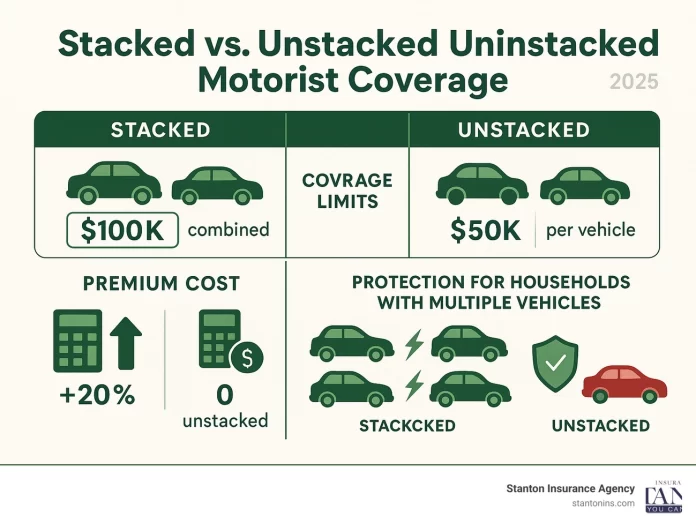
Stacked uninsured motorist coverage Florida policies could double your payout after an accident. You might stack your coverage to get $100,000 instead of $50,000 when an uninsured driver injures you.
Most Florida drivers don’t know about this valuable insurance option. Insurance companies often charge their loyal customers a lot more during renewal. One customer got a renewal quote of £368.74 but found identical coverage for £215.22 on comparison sites. Understanding stacking could help you get maximum protection without raising costs. Some areas see average annual premiums as high as $5,300, which makes the difference between stacked and unstacked uninsured motorist coverage in Florida crucial.
In this piece, we’ll look at what stacked uninsured motorist coverage means and how it works with single and multi-vehicle policies. You’ll learn about its benefits when you need them most. We’ll also cover its limitations and common scenarios where stacking might help you make smart choices about your auto insurance.
What is stacked uninsured motorist coverage in Florida?
Florida has the 5th highest number of uninsured or underinsured drivers in the country. This makes uninsured motorist (UM) coverage valuable protection for the state’s residents.
Stacked uninsured motorist coverage in Florida lets policyholders combine or “stack” UM coverage limits. You can do this with multiple vehicles or policies to create better protection after an accident with an uninsured driver.
How stacking works in single and multi-vehicle policies
Florida offers two ways to stack your coverage:
Stacking within a single policy: You can combine UM limits when you insure multiple vehicles under one policy. To cite an instance, see what happens with two cars that each have $50,000 per person/$100,000 per accident in UM coverage. Stacking doubles your protection to $100,000 per person/$200,000 per accident. With three vehicles, your limits would reach $150,000 per person/$300,000 per accident.
Stacking across different policies: Your UM coverage limits can combine when you have separate policies for different vehicles. Let’s say you have $100,000 UM coverage on one car and another $100,000 on a different vehicle. Stacking would give you $200,000 in total coverage.
Stacked vs unstacked uninsured motorist coverage Florida
These options differ in two key ways – coverage scope and cost:
Stacked coverage protects you in ANY vehicle – whether you own, borrow, rent it, or even ride a motorcycle. It also gives you much higher payout limits by combining coverage from multiple vehicles.
Non-stacked coverage costs less but only covers injuries in vehicles listed on your policy. You can’t combine insurance benefits beyond what a single policy offers.
Why Florida allows stacking and how it compares to other states
About thirty-two states allow UM coverage stacking. Florida makes this possible through a specific legal exception. Florida Statute 627.4132 states that while stacking isn’t allowed for other coverages, this rule “does not apply to uninsured motorist coverage”.
This legal exception addresses unique challenges Florida drivers face with many uninsured motorists on the road. Serious injuries often cost more than basic coverage limits can handle. Stacking provides vital extra protection, especially in busy areas like Miami, Fort Lauderdale, and West Palm Beach. These places have heavy traffic and more vehicles, which means higher chances of accidents.
How stacking can double your coverage
Stacking uninsured motorist coverage makes perfect sense if you look at the numbers. This approach multiplies your protection and creates a financial safety net that protects you from huge expenses after a serious accident.
Example: Two vehicles with $50,000 UM each
The math becomes simple yet powerful if you stack coverage on two vehicles. Let’s think over this scenario: you own two cars, each with $50,000 in UM coverage. Your claim would be limited to just $50,000 for a single accident whatever vehicle was involved without stacking. Your total available coverage jumps to $100,000 with stacking. This multiplication works the same way with more vehicles—three cars with $50,000 each would give you $150,000 in total stacked coverage.
When stacking applies and when it doesn’t
We used stacking in two ways: within a single policy (intra-policy) or across separate policies (inter-policy). Notwithstanding that, stacking benefits have some limitations:
- Non-owned vehicles: Stacking may not work if you drive a rental car or borrow a friend’s vehicle
- Company vehicles: Commercial policies usually have non-stacking clauses
- Unlisted vehicles: A new car not added to your policy won’t qualify for stacking
Stacking is a great way to get protection in unexpected scenarios. Stacked UM coverage protects you while riding a motorcycle insured separately with no UM coverage, unlike non-stacked coverage. It also covers “snowbirds” using northern vehicles with Florida policies.
What are the benefits of stacked uninsured motorist coverage Florida
Stacking does more than just double your coverage limits. Here are some practical advantages:
Broader protection follows you personally—it covers you as a driver, passenger, pedestrian, or cyclist. A larger pool of coverage helps when multiple family members get injured in the same accident. Stacking provides greater financial security against catastrophic injuries that exceed minimal policy limits quickly.
Stacked coverage costs just a bit more than non-stacked options. This is a big deal as it means that the protection increase makes it one of the most budget-friendly insurance improvements available.
Legal and policy limitations to be aware of
Legal limitations can restrict your protection under stacked uninsured motorist coverage in Florida. You should know these restrictions to avoid unexpected claim denials.
Non-stacking clauses in commercial policies
Commercial auto policies usually include clear non-stacking clauses. These rules prevent you from combining commercial coverage with personal policies. A Florida appellate case showed this limitation clearly. The plaintiffs tried to add benefits from a non-stackable commercial policy to their personal stackable policies but failed. Business vehicles rarely allow stacking options.
Owned vs. non-owned vehicle restrictions
The difference between owned and non-owned vehicles creates major coverage gaps. Non-stacked policies have this vital exclusion: “We do not provide Uninsured Motorists Coverage for bodily injury sustained by an insured while occupying any motor vehicle owned by that insured which is not insured for this coverage under this policy”. Your non-stacked coverage won’t protect you in vehicles you own unless they appear on your policy.
Out-of-state accident complications
Florida “snowbirds” deal with special challenges during out-of-state accidents. Non-stacked coverage doesn’t protect injuries in northern vehicles under Florida policies. Your policy’s stacking benefits might also face limits when you cross state lines.
Modified comparative fault and its effect on payout
Florida’s modified comparative fault law (effective March 2023) changes how all accident claims work. The new system works this way:
- You can recover damages minus your fault percentage if you’re 50% or less at fault
- You get nothing if you’re 51% or more at fault
This marks a fundamental change from Florida’s previous system. Insurance companies now avoid all liability if they prove just over 50% fault.
Common scenarios where stacking fails or succeeds
Let’s look at how stacked coverage works in ground applications to understand its strengths and limitations for Florida drivers of all types.
Rental or borrowed vehicles
Your stacked UM coverage protects you when you drive a rental car from Orlando International Airport or borrow a friend’s vehicle. Both stacked and non-stacked policies cover non-owned vehicles, but the coverage is different. Stacked coverage stays with you throughout your rental period. This gives you better protection than standard non-stacked policies.
Company cars with non-stackable policies
Business vehicles come with strict insurance rules. Many commercial policies have clauses that don’t allow stacking. This means you might only get the non-stackable benefits from the commercial policy while driving company vehicles, even if your personal auto policies have stackable UM coverage.
Motorcycles and excluded vehicles
Stacked coverage shows its real value with motorcycles. Florida has 4.77 million uninsured drivers – that’s 24% of all drivers. This makes motorcycle protection a vital concern. Your stacked UM auto policy will protect you on a separately insured motorcycle that lacks UM coverage. Regular non-stacked policies won’t cover these claims.
Out-of-state accidents and jurisdiction issues
“Snowbirds” who live in multiple states face unique challenges. A stacked UM coverage on your Florida policy protects you if you get hurt in your northern vehicle. Florida’s Long-Arm Statute lets courts handle cases involving out-of-state drivers in Florida accidents.
Non-resident relatives and policy definitions
The policy’s definition of “resident relatives” determines who gets coverage. Students who borrow their friends’ cars might face issues if they don’t fit the policy’s definitions. Insurance companies often use these details to limit coverage.
Conclusion
Stacked uninsured motorist coverage is one of the most valuable insurance options Florida drivers often overlook. This piece shows how stacking multiplies your coverage limits and can double or even triple your protection based on the number of vehicles you own. This extra layer of protection matters a lot since Florida ranks as the state with the 5th highest number of uninsured drivers nationwide.
The best part? Stacked coverage protects you personally, not just your vehicle. You’ll stay protected while driving rentals, borrowing cars, riding motorcycles, or walking as a pedestrian. While unstacked coverage costs less, it limits your protection to vehicles listed on your policy.
You need to pay special attention to commercial policies. They usually have non-stacking clauses that stop you from combining them with personal policies. Florida’s modified comparative fault law also blocks recovery if you’re more than 50% at fault for an accident. These rules make it vital to know your policy’s exact limitations.
“Snowbirds” and people who travel often get great value from stacked coverage. It protects them across state lines and multiple vehicles. The small increase in premium compared to unstacked coverage makes it one of the most affordable insurance upgrades available.
Talk to your agent about stacking options before you finalize any auto insurance policy. The gap between $50,000 and $100,000 coverage could change your life after a serious accident with an uninsured driver. Many people skip this during policy talks, but stacked uninsured motorist coverage can save you from financial disaster when you need protection most.
FAQs
Q1. What is stacked uninsured motorist coverage in Florida? Stacked uninsured motorist coverage in Florida allows you to combine the coverage limits from multiple vehicles or policies, potentially doubling or tripling your protection in case of an accident with an uninsured driver.
Q2. How does stacking work in single and multi-vehicle policies? In a single policy with multiple vehicles, you can combine the uninsured motorist coverage limits for each vehicle. For separate policies, you can stack the coverage across different vehicles, increasing your total protection.
Q3. What are the main differences between stacked and unstacked coverage? Stacked coverage provides protection while in any vehicle and allows for higher payout limits by combining coverage from multiple vehicles. Unstacked coverage is less expensive but restricts coverage to injuries sustained only in vehicles listed on your policy.
Q4. When does stacking not apply? Stacking typically doesn’t apply to non-owned vehicles like rentals, company cars with non-stacking clauses, or newly purchased vehicles not yet added to your policy. Commercial policies often have restrictions on stacking as well.
Q5. Is stacked coverage worth the extra cost? For most Florida drivers, stacked coverage offers significant benefits for a relatively small increase in premiums. It provides broader protection that follows you personally and creates a larger pool of coverage, making it a cost-effective insurance enhancement, especially in a state with a high number of uninsured drivers.

